 Spamle
How to Play Spamle: Rules, Scoring, and Better First Rounds
Learn how Spamle’s five category rounds work, how answers earn points and bonus time, and how to make clearer decisions under the clock.
You have several answers in mind, but only a few seconds to type one. Should you enter the obvious answer or spend that time reaching for something unusual? That decision is at the heart of Spamle. In this category word game, you name things that fit a prompt, and every new accepted answer resets the main clock. Familiar answers help you stay in the round; harder-to-recall answers earn more points. Knowing when to use each matters as much as knowing the category itself.
You can open Spamle and start the Daily in your browser, without an account or an app download. Here is what to look for in your first five rounds—and how to make the next attempt more deliberate.
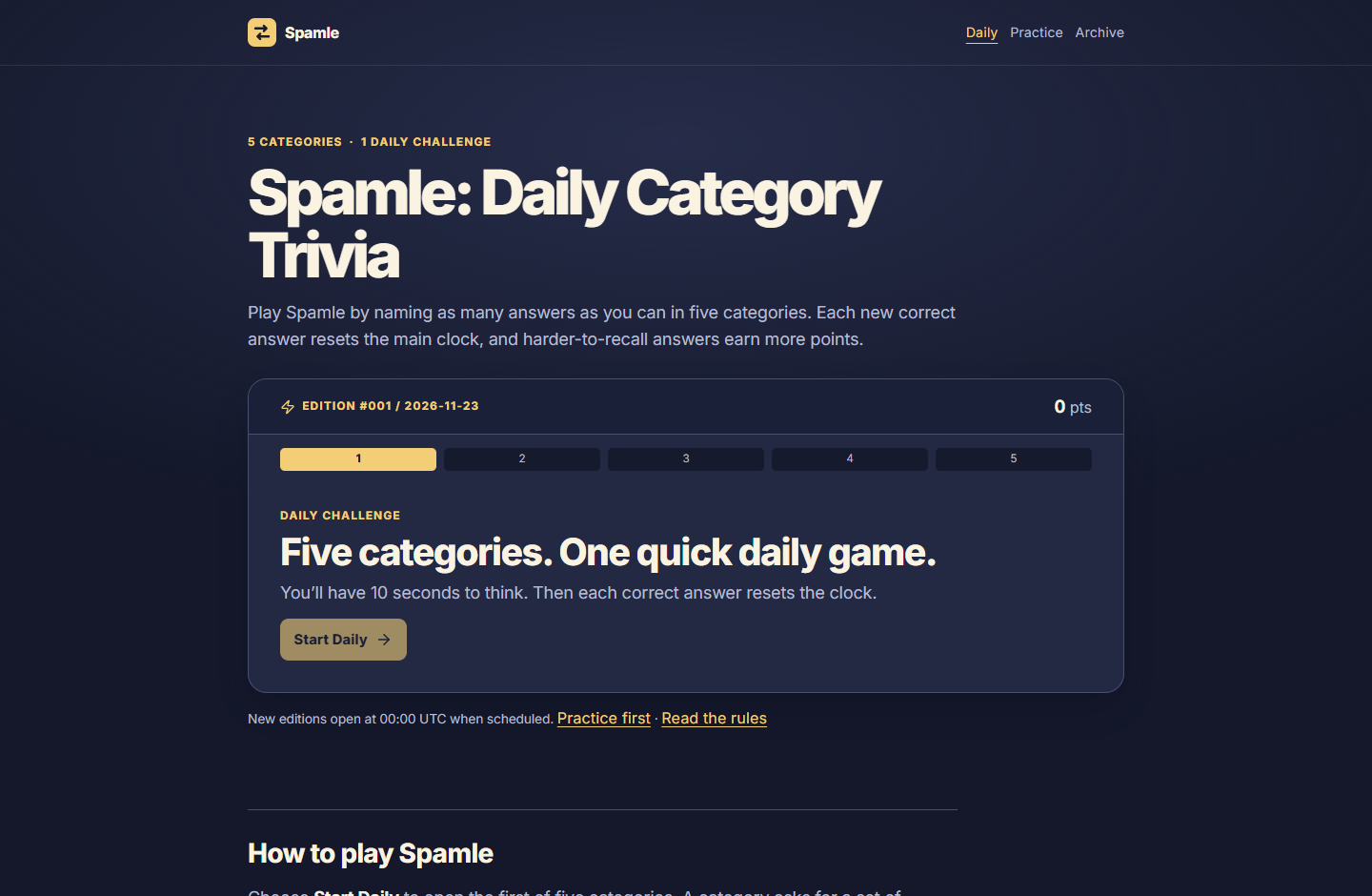
The Daily begins with five category rounds. Start each round when you are ready. Image: Spamle.
What kind of word game is Spamle?
Spamle asks you to recall multiple answers within a category. You are not solving a single hidden word or arranging letters into a particular order. A prompt establishes the subject, and a short note underneath explains which answers qualify.
That second line matters. “Name an instrument” and “Name a percussion instrument” invite different answers. A category can also specify full names or exclude related terms that would fit a looser definition. Read the complete prompt before building your list.
The Daily contains five categories played in sequence. Each round has its own score, and the final result brings your performance together. You do not need to clear every answer to move on: a round can end when time runs out, or earlier if you find the entire accepted list.
Your first round, step by step
1. Use the opening ten seconds to prepare
Choose Start Daily to reveal the first category. You then have ten seconds of thinking time before the main countdown begins.
First, check the category's scope. Next, pick an answer you can type confidently. If more names come to mind, keep one or two ready behind it. You can type a draft during think time, but you still need to submit it when answering opens. Choose Start answering if you are ready early.
You do not need an elaborate plan. A reliable opener and somewhere to look next are enough to begin.
2. Submit one distinct answer at a time
The main answer window starts at seven seconds. Type your answer and press Enter, or use Submit.
Each new correct answer resets the main clock to seven seconds, subject to the round's overall time limit. A duplicate or unrecognized guess does not deduct points, but it does not reset the clock either. The time you spend typing still passes.
Submit deliberately before the deadline. A complete, unambiguous exact answer already in the box can count at the buzzer, but partial names and ambiguous prefixes are poor things to rely on.
3. Spend the bonus you have earned
Accepted answers during the main phase also save time in a bonus bank. When the main clock expires, any banked seconds become one final answering window.
During this bonus, answers still earn points. They do not reset the countdown or add more seconds. If you are out of ideas, you can end the bonus early.
4. Review before starting the next category
The recap gives you a stopping point. No answer clock runs between rounds, so this is where to take a break—not by leaving an active round in another tab.
Choose Next round when you are ready. After the fifth category, open the final result to see the full run.
Spamle scoring: points and time are different rewards
Spamle assigns each accepted answer a value from one to five points. During the main phase, that value also determines how many seconds it contributes to the bonus bank.
| Answer tier | Points | Seconds added during the main phase |
|---|---|---|
| Common | 1 | 1 |
| Uncommon | 2 | 2 |
| Rare | 3 | 3 |
| Epic | 4 | 4 |
| Legendary | 5 | 5 |
The bank holds at most ten seconds. Once it is full, additional answers still score and reset the main clock while that phase continues, but they cannot build a longer bonus.
The tiers describe estimated recall difficulty within the prompt. They are not live percentages showing how many other players entered an answer. An Epic find is worth four points; it does not mean only a particular fraction of players knows it.
Consider this hypothetical sequence:
- A two-point answer gives you two points and two banked seconds.
- A five-point answer takes both totals to seven.
- Another five-point answer raises your score to twelve, but the bank stops at ten seconds.
- If you then enter a three-point answer during the bonus, your score reaches fifteen. The remaining bonus time keeps running down.
Notice the difference between the two clocks. The seven-second answer window is your immediate deadline. The bonus bank is time saved for later.
Three decisions that make a round easier to manage
Start with an answer you can finish
A Common answer and a Legendary answer produce the same main-clock reset. When the deadline is close, an answer you can finish typing is more useful than a valuable name you have only half remembered.
Use a certain answer to keep going. Then look for the harder one in the renewed window. You do not need to hold back familiar answers just because their point value is low.
Move through smaller groups
For a broad category, choose a route through your memory. In a geography prompt, you might move between regions. For musical instruments, you might think about a school band, an orchestra, and then instruments from other performances you remember.
Treat those groups as places to search, not as guarantees that every example qualifies. The prompt's scope still decides what belongs.
When one group dries up, switch. Repeating the same few ideas in your head consumes time without giving you a new answer.
Change your priorities in the bonus
During the main phase, a quick answer can buy another full window. During the bonus, there is no next reset to earn.
Enter the answers you already have ready. Avoid spending most of the remaining time on a long, uncertain name while two short answers are waiting. The best choice depends on what you can actually submit, not only on its potential score.
Why did an answer fail to count?
The most useful response depends on the feedback:
| What happened | What to do next |
|---|---|
| The answer was already counted | Move to a different entry; alternate names can refer to the same thing. |
| The guess was not on the list | Recheck the category boundary, then try another answer. |
| The spelling was too close to several entries | Use the full name if there is time. |
| A small typo was rejected | Do not assume every prompt uses the same typo tolerance. |
After the round, Reveal missed answers lets you inspect the accepted list. If you want another attempt without seeing the solutions first, leave that reveal closed.
One rejected guess does not erase your points. Spending the rest of the countdown trying variations of it is usually the more costly mistake.
How to judge your result fairly
Look at both points and answer count. More answers can mean you kept recalling consistently; more points with fewer answers can mean you found higher-value entries. Neither number tells the whole story alone.
For a useful comparison with a friend, play the same edition. Different categories offer different lists and scoring opportunities. Also distinguish a first attempt from a replay after studying missed answers.
The Daily result can be shared as spoiler-free text or a scorecard. Its challenge link lets a friend open the same edition. Scheduled Daily editions use midnight UTC; when no new edition is available, published games remain accessible through the Spamle Archive.
What to practice after your first five rounds
Choose one problem you noticed. Did you misunderstand a category? Did you hesitate over spelling? Did you keep searching the same small group of answers?
Use Spamle Unlimited to work on that problem in a single-category round. Relaxed gives you time to understand the list; Sprint brings back the countdown. On your next attempt, concentrate on the decision you want to improve rather than trying to change everything at once.
The first useful goal is straightforward: read the boundary, submit an answer you know, and have somewhere else to look when that first idea runs out.